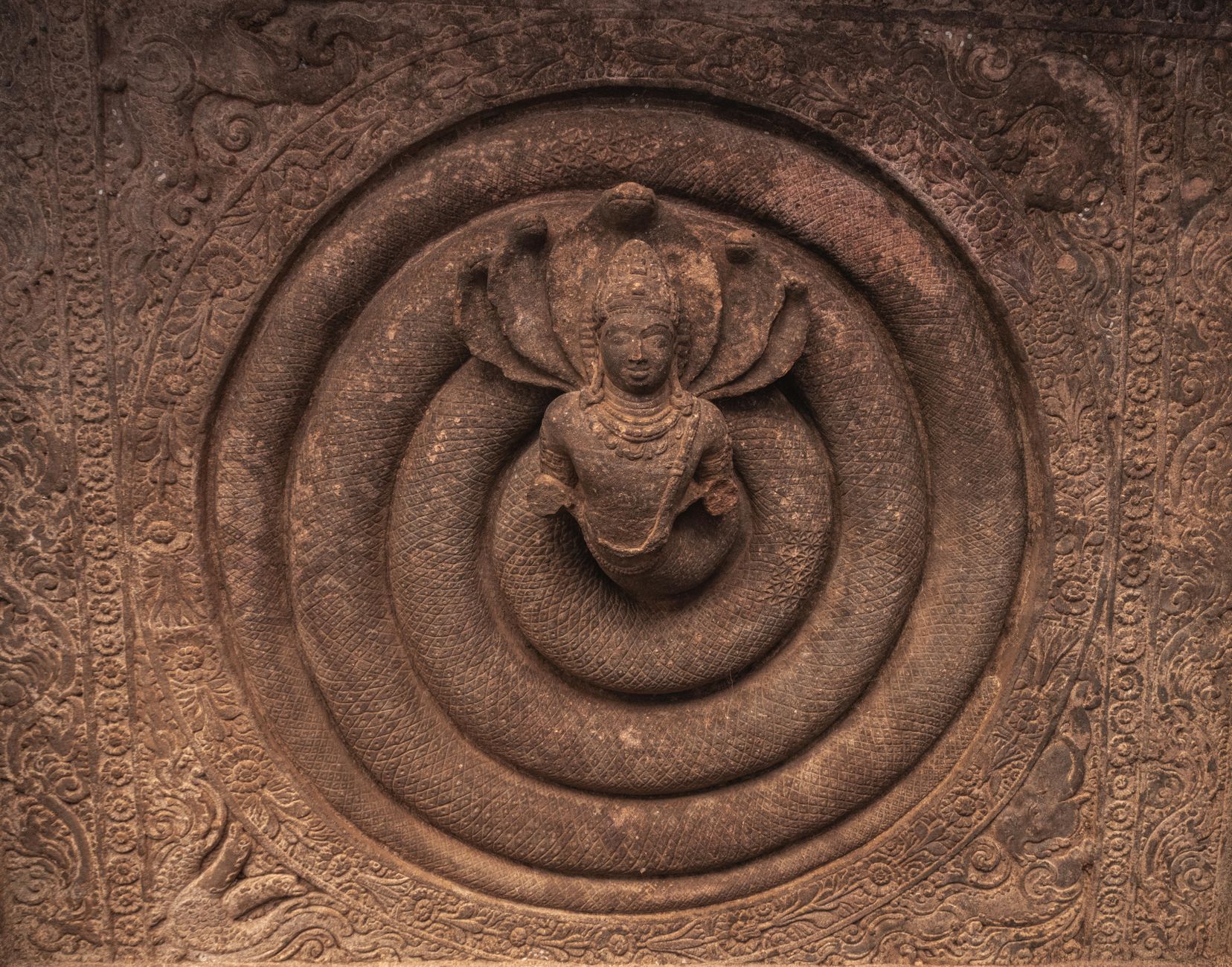
Badami's main draw centres on four rock-cut cave temples carved between the 6th and 8th centuries, though the town's real appeal spreads across its entire geography—the cinnamon-coloured cliffs enclosing the town, the quiet tank (reservoir) below them, and the lesser-visited temples and heritage structures that give context to what you're seeing.
What are the four cave temples?
The caves sit on the southern cliff face, accessible via a steep lane from the town centre. Cave 1, the oldest, is dedicated to Shiva and features intricate pillar carvings that show early Chalukyan sculptural style—notice the bracket figures and the ceiling panels depicting mythological scenes. Cave 2, dedicated to Vishnu, sits higher and feels airier; its carved pillars are considered more refined than Cave 1's. The central sanctum hosts a seated Vishnu image. Cave 3, the largest, also honours Vishnu and includes an extended columned hall where worshippers once gathered; an inscription here names the Chalukyan king Mangalesa. Cave 4 differs entirely—it's a Jain cave added centuries later (10th century), with tirthankaras (Jain masters) carved into its walls.
Inside each cave, light filters through carved window openings, casting soft patterns across stone floors. The experience is contemplative rather than visually overwhelming; you're not studying ornate decoration so much as understanding how religious practitioners used these spaces. Bring a torch or use your phone light to see ceiling details clearly.
Related: JJ Residency Bangalore: Location, Amenities & Booking Guide
Related: Bangalore to Belur Distance: Route, Time & Travel Options
Related: Things to do in Hubballi: attractions and local tips
Beyond the caves: temples and sacred sites
At the base of the cliffs sits the Bhutanatha Temple, a 7th-century structure that originally sat on an island within the tank. Today it stands on a small peninsula accessible by walking around the water's edge—this walk alone is worth the time, as you experience the town from water level and see how the cliffs curve around the settlement. The temple's compact sanctum and modest tower give a sense of everyday religious architecture without the grandeur of royal commissions.
On the northern cliff face, less visited but equally significant, sits the Upper Shivalaya Temple (sometimes called the North Cave or Natural Cave Temple). Reaching it requires climbing steps cut into the rock, but you emerge into a small chamber with carvings and a lingam (Shiva symbol). The climb rewards you with panoramic views across Badami's entire layout—the tank below, the southern caves across from you, and the flat terrain stretching beyond.
The Badami Fort ruins occupy the northern heights. Though much is degraded, walking its perimeter reveals laterite walls, cistern systems, and vantage points that explain why rulers chose this location. On a clear morning, the walk takes about 45 minutes and the light is particularly good for understanding the town's topography.
The museum and historical context
The Government Museum, situated centrally near the tank, houses sculpture fragments, inscriptions, and pottery from the Chalukyan period. It's a small collection but genuinely informative—seeing a carved bracket figure or a door jamb up close helps you appreciate the sculptural language you'll encounter in the caves. Allow 40 minutes here; the labelling is basic but sufficient.
Practicalities and atmosphere
Badami is a working town, not a museum. You'll navigate small lanes lined with local shops, schoolchildren, and people engaged in ordinary life. This authenticity is part of the experience. The tank provides the town's central gathering space, particularly in early morning when local residents bathe and walk around its perimeter. A pre-dawn stroll here, before tourist activity, captures the place as locals experience it.
The best time to visit is October through February, when temperatures are mild and cave exploration is genuinely comfortable. From March onwards, the caves become considerably warmer, and the red stone can feel oppressive in afternoon heat. If you're visiting during monsoon (July–September), paths to the Upper Shivalaya can be slippery, and the caves themselves smell of dampness rather than stone.
Spend a full day in Badami to comfortably see the four main caves, walk around the tank, climb to the Upper Shivalaya, and visit the museum. A second half-day allows exploration of the fort perimeter and quieter lanes. A rushed four-hour visit lets you see the caves and tank but misses the town's character.
How does Badami compare to other heritage sites?
Badami differs from more visited destinations like Hampi or Aihole in scale and accessibility. The caves are fewer and easier to navigate; there's less to see overall, which means you can absorb it thoroughly rather than surveying broadly. The town itself is smaller and less affected by tourism infrastructure, so it feels more lived-in. If you're interested in cave temples specifically, Badami compares closely with sites in Maharashtra like Ellora, though Ellora is larger and more complex. Badami offers a more intimate introduction to cave temple architecture.
For a Karnataka itinerary, Badami works well combined with Aihole (30 km away, famous for early stone temples) and Pattadakal (a UNESCO site 22 km away, with dravidian architecture). The three form a heritage triangle, each offering different architectural periods and styles. Alternatively, Badami stands alone as a brief but focused heritage stop on routes between north Karnataka and the plateau.
Approaching local culture
The Chalukyan dynasty, whose patrons commissioned these caves, ruled from the 6th to 8th centuries and influenced Hindu, Buddhist and Jain temple architecture across the Deccan. Learning this context before visiting deepens your experience—you're not simply looking at old carvings but understanding how three religious traditions coexisted and expressed themselves through architectural patronage. Many locals are proud of Badami's heritage and willing to discuss it; showing genuine interest goes a long way.
Food-wise, Badami's small restaurant scene focuses on South Indian basics—idli, dosa, rice-based lunches. There's nothing elaborate, and that's appropriate to the town's character. Eat where locals eat, be prepared for simple flavours, and enjoy the absence of catering-for-tourists mediocrity.
FAQ
Can you visit all four caves in one trip? Yes, easily. They're clustered on one cliff face, accessed by the same entrance lane. Spending 1.5 to 2 hours inside all four, including reading inscriptions and studying carvings, is realistic. If you're moving quickly, 45 minutes suffices for a basic walkthrough.
Is climbing to the Upper Shivalaya difficult? It's steep but manageable for anyone with reasonable fitness. The carved steps are narrow and uneven in places; use handholds and wear shoes with grip. Older visitors or those with knee issues may find it challenging, particularly in heat.
What's the best time of day to visit the caves? Early morning (8–10 am) brings clearer light and fewer visitors. By midday, the angle of sunlight changes and the caves feel less atmospheric. Late afternoon works if you're visiting the Upper Shivalaya, as the shadows enhance the cliff landscape.
Is a guide necessary? Not essential, but worthwhile. Guides familiar with the caves can explain architectural details and historical context more clearly than signage. Hire one near the entrance; costs are modest and negotiable. Alternatively, researching the site beforehand means you can interpret it independently.
Related guides: Explore more about heritage travel in nearby areas—visit our guides to [/aihole](Aihole's archaeological sites) and [/pattadakal](Pattadakal's UNESCO temples) to plan a broader heritage itinerary across the region.